TECAR Therapy
A new era for deep tissue repair
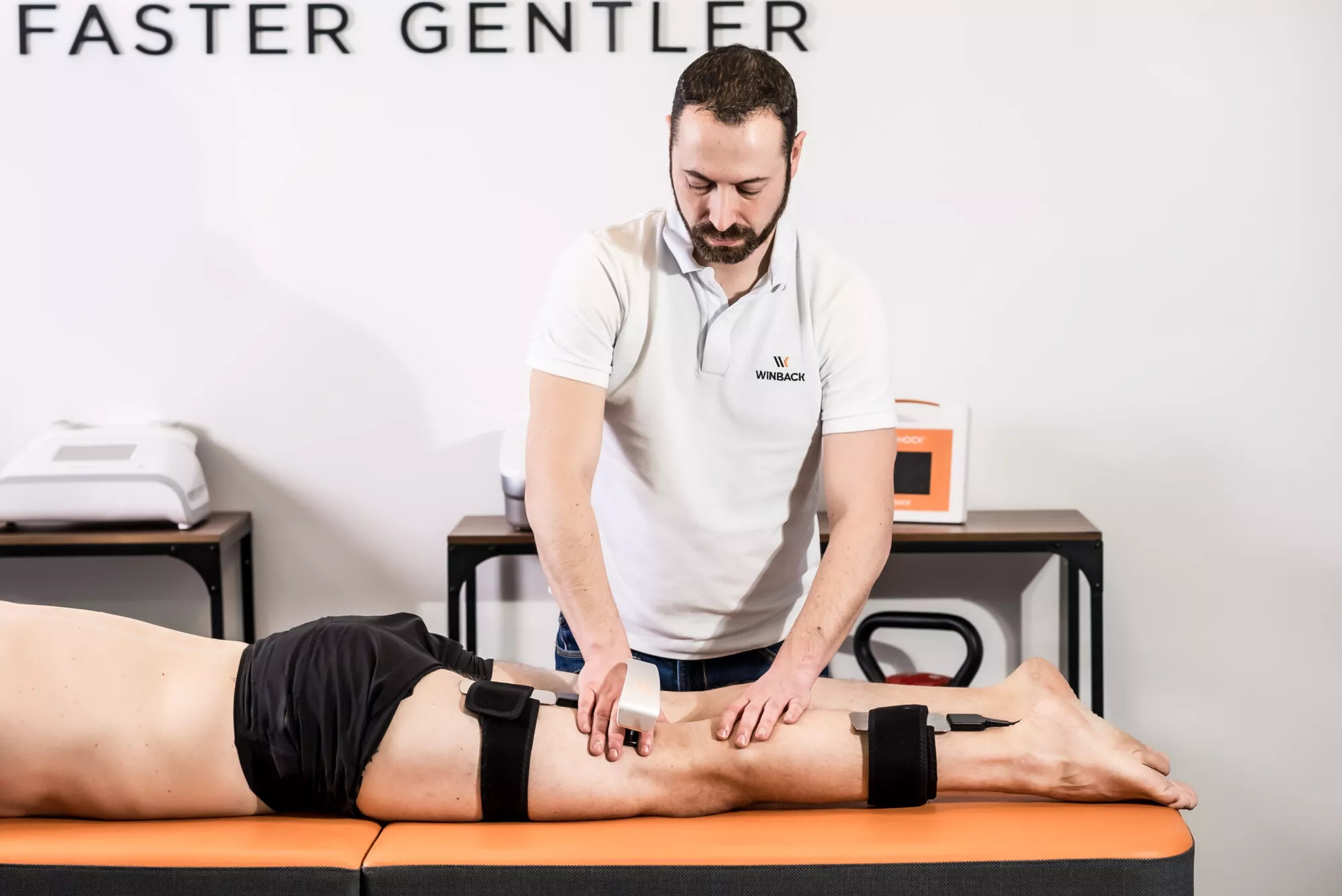
TECAR therapy – short for Transfer of Energy Capacitive and Resistive – is a non-invasive treatment where a hand-held electrode is moved across the skin to deliver gentle radio-frequency energy deep into the tissue. This energy is turned into controlled warmth inside your muscles, tendons and joints, which boosts blood flow and prompts your body to heal itself.
Whatever the cause, a stubborn injury or a slow recovery can wear you down and hold up daily life. TECAR is a drug-free, non-surgical option for a wide range of problems, with no downtime.
COMMON PROBLEMS THAT TECAR THERAPY TREATS:
- Post-knee replacement pain, stiffness and inflammation
- Post-hip replacement recovery
- Frozen shoulder (adhesive capsulitis)
- Rotator cuff injuries and shoulder pain
- Osteoarthritis-related joint pain
- Tendon injuries (Achilles, patellar)
- Muscle strains and contractures
- Back and neck pain
- Tennis elbow (epicondylitis)
- Post-surgical swelling (oedema)
- Sports and overuse injuries
TECAR reinforces the physiotherapist's hands-on work: it eases pain, frees up movement and accelerates healing, without needles, incisions or recovery time.
HOW TECAR THERAPY WORKS
Healing, warmed up from within
Unlike a heat pack that only warms the skin, TECAR generates warmth inside the tissue.
A high-frequency current passes between a hand-held electrode and a return plate, and your body turns that energy into gentle, deep heat exactly where it is needed.
TECAR therapy works by:
- Increasing blood flow and oxygen to the injured area
- Kick-starting the body's natural repair and cell-renewal processes
- Reducing pain by calming over-sensitive nerve endings
- Relaxing tight muscle and easing spasm
- Draining swelling and speeding recovery
The energy can be delivered in two ways. TECAR’s capacitive mode works on softer, water-rich tissue such as muscle; resistive mode reaches deeper, denser structures like tendons, ligaments and the bone around a joint – this is exactly why it suits post-surgical joints and shoulders so well.
Most patients need a short course of sessions, usually delivered two to three times a week; the number depends on how long you have had the problem.
THE TECHNOLOGY WE USE: THE WINBACK BACK4
We deliver TECAR using the Winback BACK4 – widely regarded as one of the most advanced TECAR devices on the market. It lets us tailor treatment precisely to your tissue and your stage of recovery, and it makes each session faster and more comfortable.
- Three treatments in one – combines TECAR, Hi-TENS and Hi-EMS currents, meaning we can move seamlessly between deep tissue, pain relief and muscle activation.
- Real-time precision – patented Power-In technology adjusts the energy automatically to your tissue while we treat, ensuring a safe, consistent dose.
- Faster sessions – treatment times are typically around half those of older TECAR machines, and more than one area can be treated at once.
- Medical-grade and non-invasive – a CE-marked medical device built to ISO 13485 standards, used by physiotherapists, sports clinics and elite athletes worldwide.
Clinically grounded
Backed by research, delivered with care
TECAR (also called tecartherapy or endogenous diathermy) is a well-established treatment in physiotherapy and sports medicine, studied in clinical trials for shoulder, knee and joint conditions and used by leading rehabilitation and professional sports teams. It works best hand-in-hand with a tailored exercise programme – not as a standalone fix.
What does TECAR energy actually feel like?
Most people describe it as a deep, pleasant warmth alongside a gentle massage. The intensity is adjustable at any moment, so it stays firmly within your comfort zone.
Which parts of the body can be treated?
TECAR can be used on the knees, hips, shoulders, elbows, back and neck, and across muscles and tendons throughout the body – wherever there is pain, stiffness, swelling or slow healing.
Can it help old or persistent problems?
Yes. TECAR is particularly useful for long-standing pain and stiffness, and for recovery that has stalled, including after surgery like joint replacements. This is because it targets the underlying circulation and tissue repair rather than just masking symptoms.
TECAR THERAPY: TOP 3 TREATABLE CONDITIONS
We use TECAR in our clinic to treat a wide range of conditions. Here are guides to the three we're asked about the most, and how treatment with the Winback BACK4 can support your recovery.
1. Post-knee replacement problems
A knee replacement is a hugely successful operation, but the weeks and months afterwards can be hard work. Swelling, pain and stiffness are normal early on, and they can make it difficult to bend the knee and get the most out of your rehabilitation.
Common challenges after a knee replacement
- Persistent swelling (oedema) around the joint
- Pain that limits how far you can bend and straighten the knee
- Stiffness and a feeling of tightness in the joint
- Weakness in the thigh (quadriceps) muscle
- Difficulty walking, climbing stairs, and returning to normal activity
How TECAR helps
By warming the tissue from within, TECAR increases circulation around the new joint, which helps drain swelling and ease pain. When the knee is more comfortable and less swollen, it becomes easier to bend, straighten and complete the strengthening exercises that drive a good long-term result. We treat the muscle and soft tissue around the joint and never directly over the metal implant.
What the research suggests:
Studies on endogenous diathermy – the same family of radio-frequency treatment as TECAR – used after knee replacement have focused on reducing post-operative pain and swelling and improving how far patients can bend the knee, alongside standard rehabilitation. It is used as a supportive add-on to your exercise programme, not a replacement for it.
2. Post-hip replacement problems
Like the knee, a hip replacement relieves long-standing arthritis pain, but full recovery of strength and comfortable movement takes time. Many people are left with weakness in the muscles around the hip, as well as lingering soreness that can slow their return to walking freely.
Common challenges after a hip replacement
- Weakness in the buttock and hip (gluteal/abductor) muscles
- Soft-tissue soreness and swelling around the surgical area
- Stiffness and reduced range of movement
- A limp or uneven gait as muscles recover
- Reduced confidence with walking, standing, and stairs
How TECAR helps
Hip-replacement recovery is largely about settling the surrounding soft tissue and rebuilding muscle – and this is where TECAR is at its strongest.
Improving circulation helps calm soreness and swelling, while the treatment supports the muscle recovery that good hip rehabilitation depends on. Easier, more comfortable movement means you can progress your strengthening and walking programme with more confidence.
What the research suggests:
Most TECAR research on joint replacement has centred on the knee, but the mechanisms it relies on – better circulation, reduced swelling and improved muscle and soft-tissue recovery – are exactly what the hip needs after surgery, particularly the muscle weakness that commonly follows. We use it as a supportive part of a structured hip rehabilitation programme.
3. Frozen shoulder and rotator cuff injuries
Frozen shoulder (adhesive capsulitis) and rotator cuff problems are among the most painful and frustrating shoulder conditions we see in the clinic. They can make everyday tasks – reaching, dressing, sleeping – genuinely difficult, and they often take a long time to settle with rest alone.
What's happening in the shoulder
- Frozen shoulder: the capsule around the joint becomes inflamed, thickened and tight, causing pain and a marked loss of movement.
- Rotator cuff injuries: the tendons that stabilise and move the shoulder become irritated, inflamed or degenerate, causing pain and weakness.
Typical symptoms
- Deep, aching shoulder pain, often worse at night
- Difficulty lifting the arm, reaching overhead or behind the back
- Stiffness that limits both active and assisted movement
- Weakness and pain when using the arm for everyday tasks
How TECAR helps
TECAR warms deep into the shoulder capsule and rotator-cuff tendons, improving blood flow, calming inflammation and easing pain. In turn, this makes the stretching and strengthening work of rehabilitation far more manageable.
For a stiff, painful shoulder, this combination of pain relief and improved movement can be the difference between a stalled recovery and real progress.
What the research suggests:
Frozen shoulder and rotator cuff pain are among the best-studied uses of TECAR. Randomised controlled trials have investigated TECAR when added to an exercise programme for frozen shoulder and reported improvements in pain and shoulder function, and a trial in shoulder impingement found TECAR delivered clinical improvements comparable to conventional physiotherapy. As always, it works best when combined with tailored exercises.
TECAR THERAPY: FREQUENTLY ASKED QUESTIONS
A practical guide for anyone considering TECAR Therapy at our clinic for the first time. If your question isn't here, please get in touch – a short conversation often helps you decide whether this is the right next step.
ABOUT THE TREATMENT
What exactly is TECAR Therapy?
TECAR stands for Transfer of Energy Capacitive and Resistive. It is a non-invasive treatment that uses high-frequency radio waves to create gentle, controlled warmth deep inside muscles, tendons, joints and bone. A hand-held electrode is moved over the skin with a conductive cream. Nothing is injected, cut or inserted. The deep warmth increases blood flow and switches on the body's natural repair processes.
How does TECAR actually work?
A high-frequency current passes between an active electrode and a return plate, and your body converts it into heat from the inside out. This raises tissue temperature, increases circulation and oxygen delivery, relaxes muscle and eases pain, and boosts the cellular exchanges that drive the healing process. Capacitive mode focuses on softer, water-rich tissue such as muscle; resistive mode reaches deeper, denser structures like tendons, ligaments and the bone around a joint. In simple terms, TECAR gives a stalled healing process a deliberate, warm nudge.
What is the Winback BACK4, and why do you use it?
The Winback BACK4 is one of the most advanced TECAR devices available. It combines three currents in one system – TECAR, Hi-TENS and Hi-EMS – so we can move between deep tissue treatment, pain relief and muscle activation without changing machines. We can even treat more than one area at once. The device’s patented Power-In technology adjusts the energy in real time to your tissue, keeping the dose safe and consistent, and treatment times are typically around half those of older TECAR machines.
WILL IT HURT? WHAT DOES IT FEEL LIKE?
Is TECAR Therapy painful?
This is the question most people ask first. TECAR is not a painful treatment. Most of our clients find it comfortable and relaxing – a deep, pleasant warmth combined with gentle massage. The intensity is adjustable at any moment, so if the warmth ever feels too strong, just tell your physiotherapist and they will turn it down for you.
What does a session actually involve?
A typical TECAR therapy appointment follows the same broad pattern:
- A brief assessment to confirm the diagnosis and check there's no reason not to proceed
- A conductive cream is applied to help transmit the energy
- Your physiotherapist moves the electrode over the area, often combined with hands-on treatment, while the warmth builds.
The active treatment usually takes around 15–30 minutes, depending on the area and your stage of recovery.
You can get up and walk out straight afterwards – no anaesthetic, no recovery room, no downtime.
Will I feel anything afterwards?
Most people simply feel warm, loosened-up and often less sore straight after a session. Many report immediate pain relief that lasts. Occasionally the skin may look a little pink or feel warm for a short while, which settles quickly. If anything feels more than mild, let your physiotherapist know.
IS IT SAFE?
How safe is TECAR Therapy?
TECAR is very safe when delivered by a trained clinician. Because it is non-invasive, there is no risk of infection from incisions, no anaesthetic and no recovery downtime. Side effects are uncommon and mild – usually no more than temporary skin redness or warmth at the treatment site.
Is there anyone TECAR isn't suitable for?
Yes, which is why we screen carefully before starting. TECAR is generally not advised if you are pregnant; have a cardiac pacemaker, defibrillator or other implanted electronic device; have active cancer or a tumour in the treatment area; have a current blood clot (thrombosis) in the area; have an active infection, fever or an open wound at the site; or have significantly reduced skin sensation over the treatment area. Caution is also needed around recent metalwork, and we treat around – not directly over – joint implants. If any of these apply, we'll talk through suitable alternatives rather than proceed.
Can it be used after a knee or hip replacement?
Yes. TECAR is well suited to recovery after joint replacement, where the main hurdles are swelling, pain, stiffness and muscle weakness around the new joint. By improving circulation and easing swelling and pain, it helps you move more comfortably and get more from your rehabilitation. We always screen first, and we always treat the surrounding soft tissue rather than directly over the implant.
HOW LONG FOR? HOW MANY SESSIONS?
How many sessions will I need?
Most people have a course of around 6–10 sessions, typically two to three times a week. The exact number depends on your condition, how long you've had it and how you respond to treatment. Some notice relief after the first session; for others the benefit builds steadily over time.
How quickly will I feel better?
It varies. Many patients feel eased and more mobile immediately after a TECAR therapy session, thanks to its pain-relieving and circulation-boosting effects. For deeper or long-standing problems, improvement tends to build across the course of treatment as healing gathers pace.
Do I still need to do my exercises?
Yes, and this really matters. TECAR works best as part of a structured rehabilitation programme rather than on its own. The treatment creates a better environment for healing and makes movement more comfortable. Your exercises then guide the tissue to rebuild strength and function. This is especially important after joint replacement and for other common issues like frozen shoulder.
COST, INSURANCE AND PRACTICALITIES
Will private health insurance cover it?
Cover for physiotherapy including TECAR varies considerably by insurer and policy, and some require a GP or consultant referral. We'd recommend checking with your insurer in advance, and we'll provide any documentation you need.
Can I drive home and go back to work?
Yes. TECAR has no enforced downtime. You can drive yourself home, return to work and carry on with your day straight away.
What should I wear and bring?
Wear comfortable, loose clothing that allows easy access to the area being treated – for example, shorts for a knee or hip, or a vest or loose top for a shoulder. Please bring any previous scan reports or clinical letters, and a list of relevant medications. If you've had recent surgery, bring any details of the procedure so we can tailor your treatment safely.
What if it doesn't work for me?
TECAR is well tolerated and helps most people, but no treatment suits everyone. We assess your suitability carefully and review progress at each visit to the clinic. If you aren't responding after the early sessions, we'll be honest about it and talk through your options rather than continue regardless. The goal is always to help you, not to finish a programme.
COMMON ISSUES WE TREAT
If one of these sounds like your situation, our guides go into more detail.
After a knee or hip replacement
- Why does my knee or hip still hurt after a "successful" replacement? – persistent pain when the surgery itself went well.
- Still limping or feeling weak after a hip replacement? – the muscle weakness that can linger once the joint is fixed.
- Getting your knee to bend again – range of movement milestones and why the early weeks count.
- How long does the swelling last? – what is normal, what is not, and what helps.
- When can I drive, work and get back to the garden? – a realistic timeline for returning to everyday activity.
Shoulder pain and stiffness
- Do you really have to wait out a frozen shoulder? – why "just be patient" is not the whole story.
READY TO GET MOVING AGAIN?
Have a question we haven't answered? A short chat before booking is often the most useful first step. Contact us or click the button below to see available appointments.
This page is for general information and is not a substitute for individual clinical assessment. Suitability for TECAR Therapy is decided on a case-by-case basis following assessment by a qualified physiotherapist. Research references describe general findings from published studies and clinical use; individual results vary.