
When a "Successful" Knee or Hip Replacement Still Hurts: Where TECAR Therapy Can Help
July 2026
You’ve done everything right. You’ve had the operation, followed the advice, put in the hours with your exercises. The X-rays look like the textbook, and your surgeon is pleased. And yet, months down the line, the joint still aches, stiffens or catches you out on the stairs.
If that is where you find yourself, the first thing worth saying is this: you are not imagining it, and you are far from alone.
Persistent pain after joint replacement is more common than people think
Knee and hip replacements are among the most successful operations in modern medicine, and for most people they deliver exactly what they promise: less pain and a return to normal life. But the research consistently finds that around one in five people still have meaningful pain a year after a total knee replacement. After a hip replacement the numbers are lower, but persistent pain still affects a notable minority.
This is sometimes described, rather bluntly, as the failures hiding among the successes. Much of the ongoing pain is mild or intermittent, and a good deal of it eases over the following months and years. But for a smaller group it lingers, and it can be genuinely wearing, because it arrives after the point at which you were promised things would be better day-to-day.
Why does pain persist when the surgery went well?
Sometimes there is a clear mechanical reason for the pain, and your surgeon will want to rule these out first. But in a large proportion of cases, the scans are clean and the implant is perfectly positioned, yet the pain remains. So what is going on?
A few things tend to be at play here:
Soft tissue that has not settled.
The muscles, tendons and other tissues around the joint go through a great deal during surgery and recovery. Lingering swelling, tightness and irritation in these structures can keep a joint sore long after the bone work has healed.
Muscle weakness that never fully recovered.
This is especially common around the hip, where the buttock and stabilising muscles can stay weak, leaving the joint feeling unsupported and achy.
A nervous system stuck on high alert.
This is the one that people rarely hear about. When pain has been present for a long time, either before surgery or after it, the nervous system can become sensitised, effectively turning up the volume on pain signals. The joint may be structurally fine, but the alarm system around it keeps on sounding.
Understanding which of these is driving your pain matters because it shapes what actually helps. One thing is for sure: persistent post-surgical pain is not usually solved by pushing harder or waiting longer on your own.
Here's what most people in your position have already tried:
- Anti-inflammatory medication and painkillers – these blunt the edge but never fix what's underneath.
- Standard physiotherapy exercises – helpful in theory, but can be agonising when the tissue isn't ready to move.
- Hot and cold therapy at home – the trusty wheat-bag and ice-pack routine that offers 10 minutes of relief but then evaporates.
- Rest and waiting – because someone said 'give it time', and time passed, and not much changed.
- A previous course of treatment that helped briefly – before the symptoms crept back the moment you resumed your normal activities.
- Cortisone injections – these may offer short bursts of relief, but they tend to get shorter with each round.
We understand the frustration that comes with this territory, and that is why we've invested in the latest technology in an effort to help our clients' recovery.
Where TECAR therapy fits in
This is the point at which many people feel stuck. The surgical chapter is closed, standard rehabilitation has run its course, and painkillers are not a long-term answer. TECAR therapy is one of the tools we use to help people move forward from exactly this position.
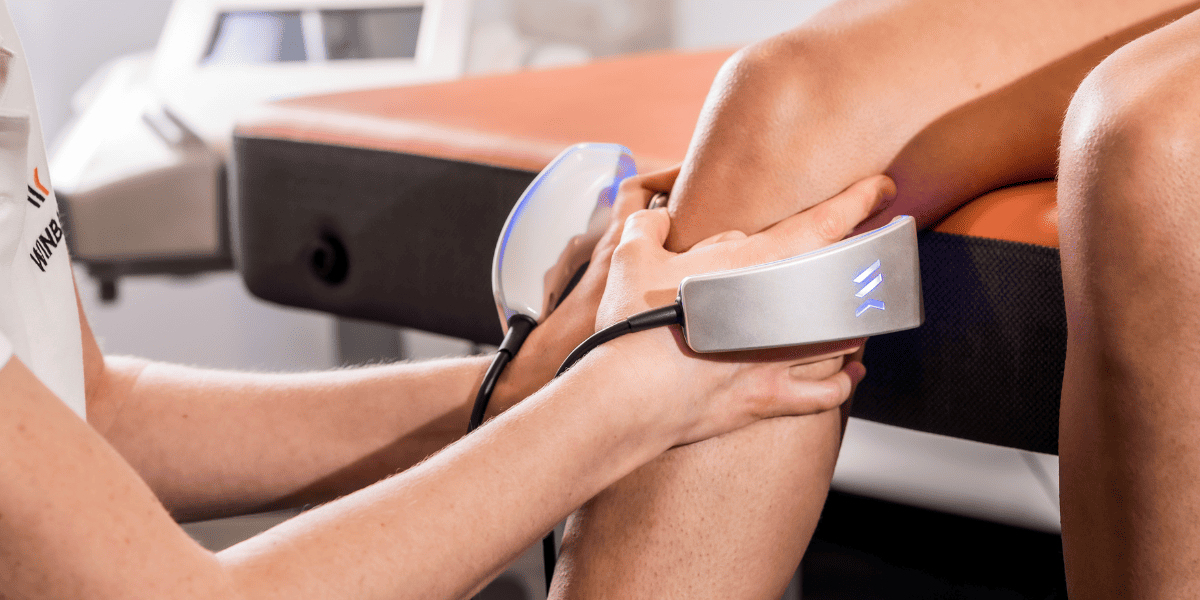
Without repeating the full explanation (there is more detail on our TECAR therapy page), TECAR is a non-invasive treatment that uses radio-frequency energy to create deep, gentle warmth inside the tissue. For someone with persistent pain after a joint replacement, that matters for a simple reason: it helps break the cycle that keeps people stuck.
A painful joint is a joint you avoid using. Avoiding it leads to more stiffness, more weakness and often more pain, which makes you avoid it further. TECAR helps interrupt that loop. By easing pain and improving circulation around the affected joint, it tends to make movement feel more comfortable, which in turn lets you do the strengthening and mobility work that genuinely changes the long-term picture.
In other words, TECAR’s real value is not as a standalone fix but as the key that reopens the door to effective rehabilitation – a door that may have been locked for a long time.
For the soft-tissue soreness and residual swelling behind so much persistent pain, it’s this combination of comfort and renewed movement that can be the difference between a recovery that has plateaued and one that starts moving again.
A word on expectations
It would be wrong to promise that any single treatment erases chronic pain, and we would never make that claim. Persistent pain after joint replacement usually has more than one cause, and it responds best to a considered, joined-up approach rather than a quick fix.
What we can offer is an honest assessment. We will look at what is actually driving your pain, check that TECAR is appropriate and safe for you (there are a few situations where it is not, and recent surgery always calls for care), and we’ll be straightforward about whether it is likely to help. If it is, we use it as one part of a tailored plan alongside hands-on treatment and the right rehabilitation exercises. If it is not the right tool for you, we will say so and talk through the alternatives.
If you are still in pain, it is worth a conversation
Living with pain after an operation that was meant to end it is a particular kind of disheartening. But a plateau is not the same as a dead end, and "the scan looks fine" is not the same as "nothing more can be done".
If your knee or hip is still holding you back months after your replacement, book an appointment or get in touch. A short conversation is often the most useful first step towards getting moving again.
Related reading
TECAR therapy: how it works and what we treat – the full picture of the treatment and the conditions it suits.
Still limping after a hip replacement? – if the problem is more weakness and limping than pain, this one is for you.
How long should the swelling last? – when a puffy joint is normal healing and when to get it checked.
This article is for general information and is not a substitute for individual clinical assessment. Persistent pain after surgery should always be reviewed by an appropriate clinician, and suitability for TECAR therapy is decided on a case-by-case basis following assessment.