Your Hip Replacement Fixed the Joint. Now the Muscles Need to Catch Up.
July 2026
A hip replacement is very good at one thing: getting rid of the grinding, arthritic pain that made walking a misery. For most people, that part works beautifully. But a fair few come away puzzled by what is left behind. The deep joint pain has gone, and yet the leg feels weak, the walk is not quite right, and there is a limp that simply will not shift.
If that sounds familiar, the issue often is not the new joint at all. It is the muscles around it.
Why the muscles are the part that lags
Two things tend to leave the hip muscles struggling after a replacement, and understanding both helps explain why recovery can feel slower than expected.
The first happens long before the operation. Living with an arthritic hip for years means walking less, favouring the leg, and gradually letting the muscles waste. By the time you reach surgery, the key muscles are often already weak and shrunken, and that head-start on deconditioning does not vanish when the joint is replaced.
The second is the surgery itself. Getting to the hip joint means working through and around muscle, and the surrounding tissue needs time to settle and recover afterwards. The result is that the muscles that stabilise and drive the hip are asked to do a highly demanding job while they are still at their weakest.
The muscles that matter the most post-surgery
The main culprits here are the hip abductors, chiefly the gluteus medius and minimus – the muscles on the side of your hip that keep your pelvis level as you walk. When they are weak, the effects are surprisingly wide-ranging:
A limp or a "rolling" walk
Weak abductors let the pelvis dip with each step, which is the classic post-hip-replacement gait that people find so frustrating.
A sense of instability
The leg can feel as though it might give way at any moment, or simply not feel trustworthy, which knocks your confidence, especially on stairs and uneven ground.
Aches and pains that spread elsewhere
When the hip muscles are not pulling their weight, your body compensates, and that extra load often shows up as lower-back, knee or opposite-hip discomfort. In other words, a weak hip rarely stays a hip-only problem.
None of this means that the operation failed. It just means that the joint is ready before the muscles are, and the gap between the two is exactly what rehabilitation is meant to close.
Why post-op strengthening sometimes stalls
Ultimately, the answer to weak hip muscles is to strengthen them, and a well-designed exercise programme is the backbone of any good hip recovery. But two things commonly get in the way early on.
One is lingering soft-tissue soreness around the operated area, which makes people guard the leg and hold back from loading it properly.
The other is more subtle: after months or years of underuse, some muscles seem reluctant to switch back on and fire the way they should, so even honest effort in the gym does not translate into the pelvis staying level when you walk. Your progress plateaus, and it becomes easy to assume that’s as good as it gets.
Where TECAR therapy fits in
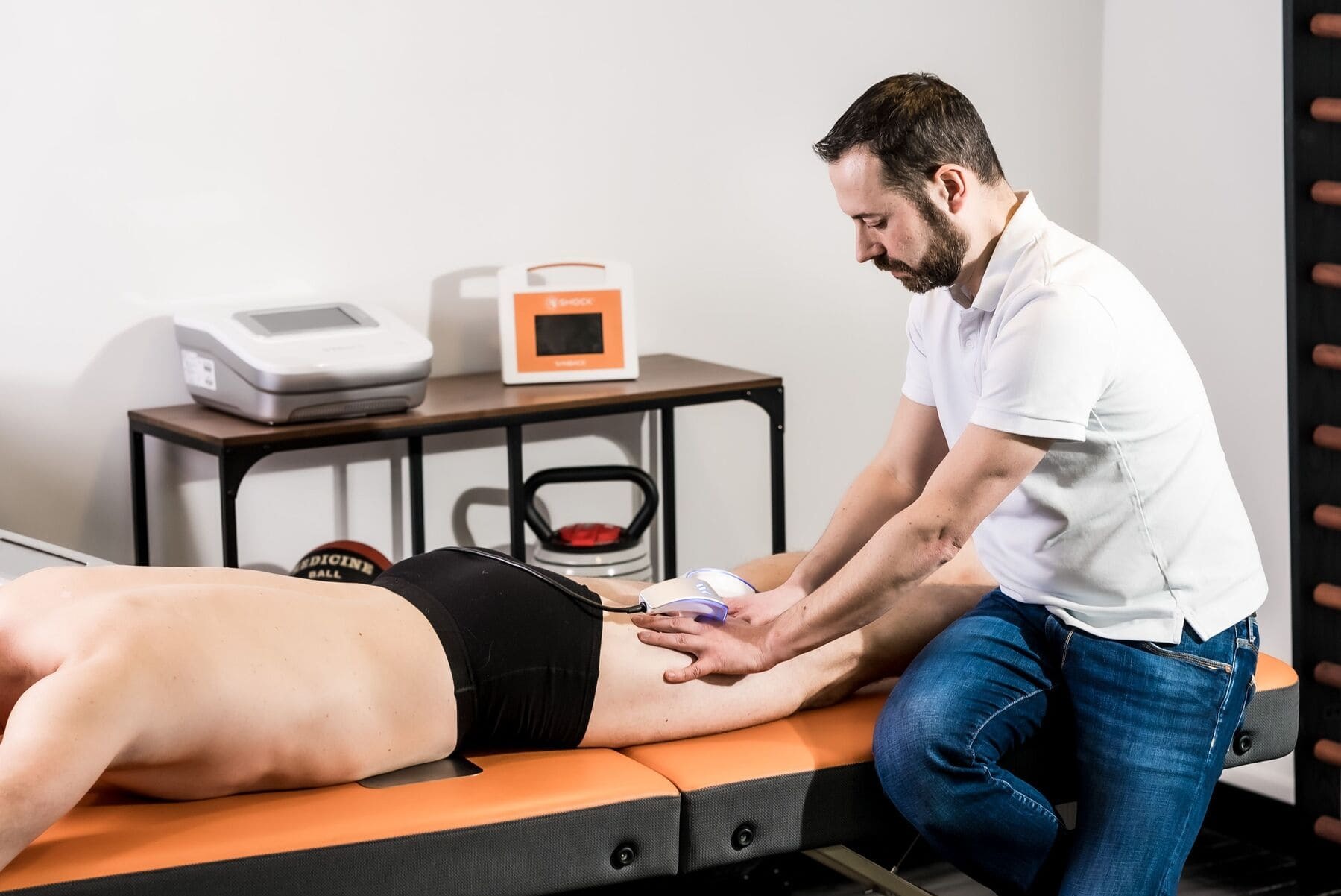
This is the point where TECAR therapy earns its place. As explained more fully on our page on how TECAR therapy works, it uses radio-frequency energy to create deep, gentle warmth in the tissue, and hip recovery happens to play directly to its strengths, because so much of the job here is soft-tissue and muscle recovery rather than the joint itself.
In practical terms, this helps on two fronts. By improving circulation and easing residual soreness, TECAR makes the operated area more comfortable to load, so you can commit to your strengthening rather than protecting the leg. And the device we use, the Winback BACK4, pairs TECAR warmth with muscle-stimulation currents (Hi-EMS), which can help coax reluctant hip muscles back into action, giving your strengthening work something to build on.
TECAR does not replace the hard work of rehabilitation, and no amount of warmth alone will rebuild a muscle. Progressive strengthening is what restores a level, confident walk. What TECAR does is create better conditions for that work to take hold, and help re-engage muscles that have gone quiet, so the effort you put in actually shows up in how you move.
Getting your walk/life back
A limp or a weak, untrustworthy leg months after a hip replacement is not something you simply have to accept, and it is rarely a sign that anything has gone wrong with the joint. It usually means the muscles still have some catching up to do, and that is a solvable problem with the right, targeted approach.
If your hip feels weak, unsteady or is leaving you with a limp, book an appointment or get in touch. We can assess how the muscles around your new hip are working and talk through whether TECAR therapy, alongside a focused strengthening plan, could help you walk more freely again.
Related reading
TECAR therapy and soft-tissue recovery – how the treatment supports healing after surgery and injury.
Why some joints still hurt after a replacement – if pain rather than weakness is your main issue, start here.
When can I drive, work and get back to the garden? – the milestones to expect as strength returns.
This article is for general information and is not a substitute for individual clinical assessment. Weakness or a limp after hip replacement can have several causes that should be properly reviewed, and suitability for TECAR therapy is decided on a case-by-case basis following assessment.