
Why Changing How You Walk Changes How Your Knee Feels: The Science Behind AposHealth
September 2026
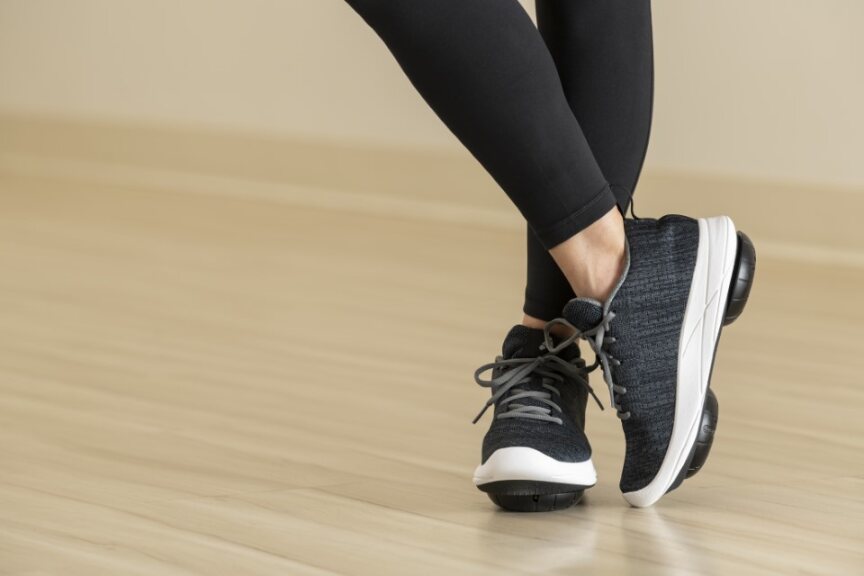
At first glance, AposHealth can seem an odd proposition. You’re given what look like trainers with two curved pods bolted to the soles, told to wear them around the house for about an hour a day, and asked to believe that this will help a painful arthritic knee. It’s a reasonable moment to raise an eyebrow!
The idea underneath AposHealth is more interesting than the footwear suggests, and it rests on two separate mechanisms working together. One is immediate and mechanical. The other is slower, and it explains why the benefit carries over into the hours when you’re just wearing your ordinary shoes.
Mechanism 1: moving the load off the sore part of the joint
When your knee is not loaded evenly, force passes through the joint along a line dictated by the position of your foot, the alignment of your leg, and where your weight falls with each step as you walk. In knee osteoarthritis, the cartilage wear is usually worse on one side, most often the inner (medial) compartment, so every step concentrates the load exactly where the joint is least able to tolerate it.
The AposHealth pods change where the centre of pressure sits under your foot. Shift that point, and you shift the line of force travelling up through the leg. Adjust it well, and a meaningful share of the load moves away from the worn, painful part of the joint towards a part that copes with it better.
This is why calibration takes time and has to be done by a trained clinician. The pods are adjustable in position and height, and the difference between a setup that helps and one that does nothing is small. Your clinician changes a pod, watches you walk, checks what your symptoms do, and repeats. In this way, the device is being tuned specifically to your knee and your gait.
Mechanism 2: making your muscles work harder, on purpose
The second mechanism is the counterintuitive one. The AposHealth pods are convex, so they are deliberately a little unstable underfoot. As a result, every step you take becomes a small balance challenge that the muscles around your hip, knee and ankle have to respond to.
This is known as a form of perturbation training. By repeatedly presenting the nervous system with mild, controlled instability, you prompt the muscles that stabilise the joint to fire more quickly and in better coordination. Muscle control is then trained through repeated demand rather than through conscious effort, which is why the wearing time is spread through ordinary daily activity instead of concentrated into a formal exercise session.
Over time, the calibration is progressively increased. As your control improves, the clinician can make the pods more challenging, in much the same way that you would add weight to a strength programme once the current load becomes easily manageable.
Why the effect persists after you take them off
This is the part that surprises people. If the AposHealth pods only redirected load, the benefit would stop the moment you changed shoes.
What appears to happen is that the movement patterns you rehearse while wearing the device begin to carry over. Your nervous system does not maintain a separate walking pattern for each pair of shoes. Train more balanced muscle activation and better joint control for an hour a day, and that adjusted pattern starts to show up in how you walk the rest of the time. Studies looking at gait have recorded improvements in walking speed, step length and how long people spend loading the affected leg, measured while wearing normal footwear.
So the AposHealth footwear is best understood as a training tool rather than a support. Insoles and orthopaedic shoes cushion and support you while you have them on. AposHealth works to change the way you move, with the aim that the change stays with you.
What the evidence says
AposHealth has been assessed by NICE in the UK, which is a genuine mark of scrutiny. The reviewers concluded that it improves pain, stiffness and function compared with a sham device in high-quality trial conditions.
They were also clear about the limitations. It remains uncertain how clinically meaningful the size of that improvement is for the average patient. There is very little research comparing AposHealth directly against standard non-surgical care. And while a UK study found that most users who met the referral criteria for knee replacement had not gone on to have surgery, that finding comes from studies without a comparison group, so how much of the delay is attributable to the device is unclear.
None of that makes it a poor option. It does mean that sensible framing is a well-evidenced way of reducing symptoms and improving how you move, with promising but incomplete evidence on surgery delay.
Is it worth considering?
AposHealth tends to suit people with knee osteoarthritis who have already tried the standard conservative measures without finding enough benefit, and who would prefer to postpone or avoid surgery. It works best alongside physiotherapy rather than instead of it, since the strengthening work and the gait retraining pull in the same direction.
The starting point is an assessment and gait analysis in our clinic, which will establish whether your particular pattern of symptoms and walking is one that the device can usefully change.
Book an appointment or get in touch if you would like to talk it through with an expert.
Related reading
AposHealth at Atkins Physio – what the treatment involves and how to get started.
Discover AposHealth: a new option for joint pain relief – an introduction to the treatment process, costs and common questions.
This article is for general information and is not a substitute for individual clinical assessment. Suitability for AposHealth is decided following assessment by a trained clinician.