Tecar or Shockwave Therapy: Which One Do You Actually Need?
September 2026
If you have been researching treatment for a stubborn injury, you have probably come across both Tecar therapy and Shockwave therapy. Both are often mentioned in the same breath, both are described as advanced, non-invasive and drug-free, and it isn’t immediately obvious how they differ or why a clinic might recommend one over the other.
In fact, Tecar and Shockwave are genuinely different treatments that do different jobs. Here’s our guide on how to tell them apart.
The basic difference between Tecar and Shockwave
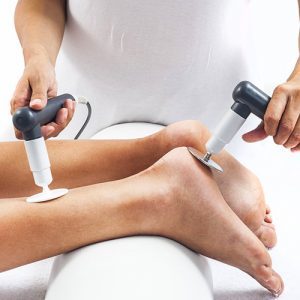
Shockwave Therapy delivers acoustic pressure waves into the tissue. These are mechanical pulses, and the treatment head produces a rapid tapping sensation against the skin. The waves create a controlled mechanical disturbance in the target tissue.
TECAR Therapy delivers radio-frequency energy, which the body converts into heat deep inside the tissue. The sensation is a spreading warmth rather than tapping, and the treatment head is moved smoothly over the skin with a conductive cream.
So Shockwave works through mechanical force, whereas Tecar works through deep, controlled heat. It’s this difference in physics that drives everything else about how they are used to treat injuries and other conditions.
What each one is trying to achieve
Shockwave is provocative by design. Its main use is chronic tendon problems that have stopped healing, where the tissue has settled into a degenerative state and simply stalled. The mechanical pulses irritate that dormant tissue enough to restart an active healing response, and they can help break down calcific deposits. The treatment is deliberately stimulating rather than soothing.
Tecar is restorative by design. The deep warmth increases local circulation and oxygen delivery, relaxes muscle, eases pain and helps disperse swelling. Rather than provoking a stalled tissue, it improves the natural conditions in which recovery happens.
What each tends to be used for
Shockwave is generally the stronger candidate for:
- Plantar fasciitis and persistent heel pain
- Achilles and patellar tendinopathy
- Tennis and golfer's elbow
- Calcific tendinopathy in the shoulder
- Longstanding tendon problems that have not responded to months of loading exercises
Tecar tends to be the better fit for:
- Recovery after knee or hip replacement, including swelling and stiffness
- Frozen shoulder and painful, stiff joints
- Muscle strains and ligament sprains, spasm and post-exercise recovery
- Soft-tissue healing and oedema after surgery or injury
- Back and neck pain
- Situations where the area is too painful or too acute for Shockwave
What the different sessions feel like
This is a practical difference worth knowing in advance.
Shockwave is usually tolerable but can be uncomfortable, particularly over a bony area or an angry tendon. The intensity is adjusted to what you can manage, and it is common to feel sore for a day or two afterwards. A typical course is short, often three to six sessions about a week apart.
TECAR is comfortable, and most people find it relaxing. It usually involves more sessions than Shockwave, commonly six to ten, often two or three times a week.
Both treatments leave you free to drive home and carry on with your day.
How a physiotherapist chooses between Tecar and Shockwave
The choice comes down to what is wrong with the tissue rather than what the machine can do.
The first question is whether the problem is a stalled, degenerative tendon. If it is, and it has been going on for months despite sensible loading work, Shockwave is usually the more logical tool.
The second question is whether the dominant problems are pain, swelling, stiffness or muscle recovery, particularly in the aftermath of surgery. In such cases, Tecar is generally the better match.
Timing matters here, too. Shockwave suits chronic, established problems and is generally avoided in the acute stage of an injury or over a recent surgical site. Tecar can often be introduced far earlier in a recovery.
The two also work perfectly well in sequence. A stubborn Achilles might be treated with Shockwave to restart the healing process, with Tecar used alongside or afterwards to manage soreness and support the loading programme as part of the rehab.
So Tecar and Shockwave are not competing options so much as different instruments for different jobs.
One thing they have in common
Neither treatment does the job on its own. Both are adjuncts, and both work considerably better when paired with the right exercise programme. Shockwave restarts a stalled tendon, but it’s progressive loading that rebuilds it. Tecar calms a joint and improves circulation, but it’s movement and strengthening that ultimately restore function.
Still unsure which applies to you?
You don’t need to work this out yourself. The whole point of an assessment is to establish what is actually wrong with the tissue, at which stage, and then to choose accordingly. Sometimes the answer is neither, and a well-designed exercise programme is the right next step. We’ll always run through the options available to you based on our clinical judgment.
Book an appointment or get in touch, and we can talk through which approach fits your problem.
Related reading
TECAR therapy – how it works and the conditions it suits.
Shockwave therapy – the treatment explained, including what to expect from a course.
This article is for general information and is not a substitute for individual clinical assessment. Suitability for either treatment is decided on a case-by-case basis following assessment by a qualified physiotherapist.